

There is a countdown running underneath every manufacturing site in the United Kingdom, and very few network teams have it on a dashboard. By January 2027 the analogue telephone network that has quietly carried a surprising amount of industrial infrastructure is due to be retired. The Government guidance on the transition from analogue to digital landlines is unusually blunt about where the responsibility sits: communications providers will not know which devices are connected to their network, so businesses must review what they are running and decide what needs replacing, upgrading or adapting.
For an office, that is a phone system project. For a factory, a distribution centre or a process plant, it is something else entirely. It is an audit of every copper pair that has been sitting in a comms cupboard since before most of the current engineering team joined.
What actually breaks when the copper goes quiet
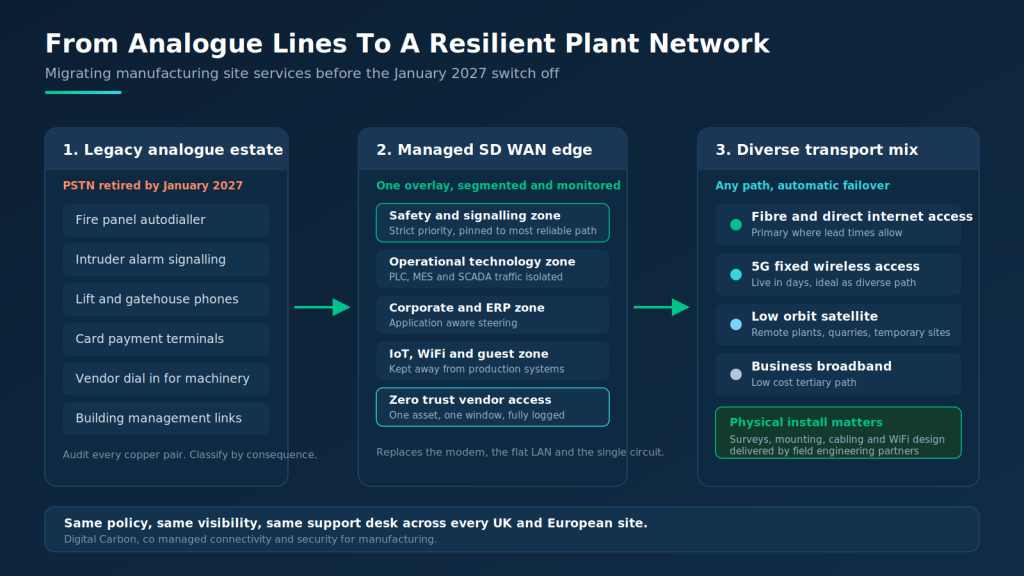
Walk any established UK manufacturing site and you will find analogue lines doing work nobody documented. Fire panel autodiallers. Intruder alarm signalling paths. Lift emergency phones in the goods tower. Gatehouse intercoms and barrier controls. Card payment terminals in the staff canteen. Out of hours modem links that a machine builder in Germany or Italy uses to dial into a press or a filler when something goes wrong at two in the morning. Legacy building management systems. Weighbridge links. The occasional serial connection between a supervisory system and a piece of equipment that predates Ethernet on the plant floor entirely.
None of these are glamorous. All of them are the kind of thing that stops production, invalidates an insurance position or fails an audit when it goes silent. And because the analogue estate has been reliable for decades, it is almost never in the CMDB.
The uncomfortable part for IT leadership is that the switch off does not simply move these services onto a digital line. It moves them onto the data network. Which means a set of safety critical and compliance critical services that used to be somebody else’s problem is about to become the responsibility of the team that runs the WAN.
This is a network architecture question, not a telephony question
Once alarms, lift lines, access control, payments and vendor remote access all ride the same circuit as ERP traffic, MES telemetry and video, the resilience conversation changes shape.
A single fibre circuit into a plant was tolerable when the alarm had its own copper path. It is not tolerable when the same circuit carries the fire panel signalling. Diverse transport stops being a nice to have on the risk register and becomes a design requirement. So does traffic separation, because a legacy autodialler adapter or a vendor jump box should not be sharing a flat network with process control systems.
This is the point at which modern SD WAN solutions stop looking like a cost saving exercise on MPLS and start looking like the only sensible way to run a plant. The relevant capabilities are specific:
Transport independence. The edge device treats fibre, broadband, 4G and 5G fixed wireless and low orbit satellite as interchangeable paths. If the primary circuit is cut by a contractor’s digger in the car park, alarm signalling and payment traffic move without anyone noticing.
Application aware steering. Not all traffic deserves equal treatment. Signalling and control traffic can be pinned to the most reliable path and given strict priority, while backups and software updates take the cheaper route.
Segmentation that is actually enforced. Corporate, guest, IoT, building services and operational technology can be separated in policy rather than in patch panels, which matters enormously when you are onboarding a dozen newly digital services in a single year.
Secure remote connectivity for third parties. Replacing dial in modems with zero trust access gives a machine builder a route to one asset for one maintenance window, logged and revocable, instead of a permanent hole in the perimeter.
Centralised visibility. When something does fail at two in the morning, the shift manager needs an answer faster than a ticket queue can produce one.
These are the practical SD WAN benefits that matter in an industrial context, and they are the reason the switch off is best treated as an infrastructure refresh rather than a line by line replacement exercise.
The sites the fibre map forgot
Manufacturing rarely happens in city centres. Quarries, aggregate plants, food processing sites, rural distribution hubs, temporary production units and construction phase facilities routinely sit outside the reach of a sensible fibre lead time. Anyone who has waited eleven months for a wayleave knows the feeling.
This is where the connectivity mix has genuinely changed in the last two years. Low orbit satellite has moved from a contingency option to a credible primary or secondary path, with latency now good enough for most business applications and for the great majority of monitoring and signalling traffic. Combine it with 5G fixed wireless access and you can bring a remote site to a working standard of service in days rather than quarters, then keep satellite in place as the diverse path once fibre eventually lands.
The catch is that none of this works without a competent physical install. Antenna siting, line of sight surveys, mast and roof mounting, cable routing through a hostile industrial environment, sealing, earthing and a WiFi design that survives racking, metal and moisture. It is the least discussed and most commonly underestimated part of the project. For physical deployment we work with our install partner StarLink Solutions, whose field teams cover satellite internet solutions, Starlink installation across the UK, 5G broadband installation and enterprise WiFi installation for exactly this kind of site. Getting the survey right at the start is what separates a two day commissioning from a two month argument.
Why global connectivity makes this harder, and easier
Very few manufacturers operate a single site. A typical group runs UK plants alongside facilities in Poland, the Netherlands, Spain or the Czech Republic, plus contract manufacturing partners further afield. Each country is retiring legacy voice services on its own timetable, with its own regulatory quirks, its own incumbent behaviour and its own supplier landscape.
Handled badly, that becomes fifteen separate projects with fifteen different contracts and no consistent security posture. Handled well, it becomes the reason to consolidate. A single overlay across every site gives you one policy model, one view of performance and one escalation path, regardless of whether the underlay in Rotterdam is fibre and the underlay in a Yorkshire quarry is satellite. That is the real argument for global connectivity delivered as a managed service: not cheaper bandwidth, but one consistent operating model across a very inconsistent set of local markets.
It also matters for compliance. European network and information security obligations have widened considerably, and manufacturing supply chains are firmly in scope. Being able to demonstrate segmentation, monitored access and documented resilience across every site is a far easier conversation when it is one platform rather than fifteen.
A realistic plan for the time remaining
There are roughly seventeen months left. That is enough, provided the audit starts now.
- Find every analogue line. Billing records, comms room surveys, facilities contracts and maintenance agreements. Assume the list is incomplete until a site engineer has physically walked the cupboards.
- Classify by consequence. A fire panel autodialler is not the same risk as a canteen phone. Sort by what happens to production, safety and insurance if the service fails.
- Decide replace, adapt or retire. A meaningful proportion of these lines are supporting equipment that should have been decommissioned years ago. Retiring them is the cheapest available option.
- Design the transport mix per site. Fibre where it exists and can be delivered in time, 5G fixed wireless and low orbit satellite where it cannot, and a diverse second path everywhere that carries a safety or compliance service.
- Book the surveys early. Install capacity across the UK will tighten sharply through 2026 as everyone reaches the same conclusion at the same time.
- Test the failover properly. Not a config review. An actual circuit pull during a live shift, with the alarm path and the payment path watched end to end.
What good looks like
The manufacturers who come through this well will not be the ones who spent the most. They will be the ones who treated a telephony deadline as the prompt to fix an architecture that was already creaking, and who chose a partner able to design, install, secure and support the result rather than simply selling circuits.
That is the practical test worth applying to managed SD WAN providers this year. Can they survey and install at a remote plant as competently as they can configure an overlay? Can they run the network with your team rather than around it? Can they cover every country you operate in with the same policy and the same support desk? Can they get a service live before the deadline rather than after it?
If those questions are on your agenda, the next step is a conversation with people who have done it on live production sites.
Ready to get ahead of the deadline?
Our network architects run practical workshops for manufacturing IT teams: an analogue estate audit, a resilience review of your current sites and a costed transport plan for the sites that fibre will not reach in time.