

Your Network Supplier Is About to Be Regulated: What the Cyber Security and Resilience Bill Means for Logistics Networks
It is 02:40 on a Sunday at a regional distribution centre somewhere off the M6. Forty trailers are booked in before the morning trunk out. The warehouse management system slows, then stops accepting scans. The site manager rings the service desk. Somebody, somewhere, begins the familiar process of working out whether this is a software fault, a link problem, or something rather worse.
Until now, the honest answer to “what actually happened” could take a week to assemble, and often nobody outside the business ever asked for it. That is the part which is changing. The Cyber Security and Resilience (Network and Information Systems) Bill reached report stage in the House of Lords in September 2026, and when it becomes law it will reshape not only what transport and logistics operators must do, but what their suppliers must do as well. For the first time, the companies that run your wide area network are being pulled inside the regulatory perimeter with you.
For IT directors and network engineers in logistics, this is not a compliance footnote. It changes what you should expect from managed SD WAN providers, and it changes the questions you ask before you sign the next three year contract.
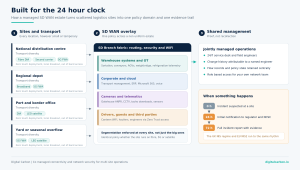
One policy domain, one evidence trail: what a regulation ready logistics network looks like.
What the Bill actually changes
Transport is not a newcomer to this regime. Operators of essential services in transport have sat inside the Network and Information Systems Regulations 2018 for years. The Bill amends and widens that framework, and three changes matter most to anyone running a distributed logistics estate.
First, managed service providers come into scope. Organisations that provide IT management, monitoring and administration with privileged access into customer systems become regulated entities in their own right. Your network partner will carry duties of its own rather than simply inheriting yours through a contract schedule.
Second, the supply chain becomes explicit. Regulators gain the ability to designate critical suppliers, where the disruption of that supplier would have a significant effect on essential services. If a single provider carries connectivity and security policy for your entire national depot estate, that is precisely the kind of concentration the designation exists to capture.
Third, reporting gets faster and broader. The Bill introduces a two stage structure: an initial notification to the regulator and the National Cyber Security Centre within 24 hours of becoming aware of a significant incident, followed by a fuller report within 72 hours. The definition of significant widens too, moving beyond service interruption to include incidents capable of significant impact on service delivery, data confidentiality or system integrity. Security measures are expected to align with the NCSC Cyber Assessment Framework, which is an evidence based framework rather than a checklist. You can follow the Bill’s progress on the UK Parliament bill page.
A 24 hour clock is the detail that should focus minds. In the depot scenario above, the clock starts when somebody realises this might be an incident, not when the investigation concludes. If your logs live in three tools owned by two companies and nobody can produce a timeline before Monday, you have a process problem long before you have a legal one.
Why logistics feels this more acutely than most sectors
Every sector complains about its own complexity, but the logistics network genuinely is an awkward shape.
The estate is scattered and uneven. A national distribution centre with resilient fibre sits in the same policy domain as a cross dock unit on a short lease, a port office, a fuel yard, a transhipment site in Kent and an overflow yard that exists for eleven weeks a year. Some of those sites will never see a fibre circuit within their commercial lifetime.
The technology mix is unusually broad. Sortation lines, conveyors, automated guided vehicles, weighbridges, number plate recognition at the gatehouse, refrigeration telemetry on chilled bays, tachograph downloads and handheld terminals all share a building with the corporate estate. Operational systems rarely patch on the same cadence as the office estate, and some of them cannot be patched at all without a planned production stop.
The user base is not only your own staff. Third party hauliers, agency drivers, customs agents, contract engineers and equipment vendors all need some form of access. Flat remote access built for a smaller business tends to survive into a much larger one, and it is exactly the kind of legacy that supply chain duties are designed to surface.
Finally, there is no maintenance window. A retailer can close the doors at six. A logistics operation runs the night trunk, the morning pick and the afternoon reverse flows, then repeats. Resilience is not a nice property of the design; it is the only way the estate can be maintained at all.
The European half of the map
Very few UK operators stop at Dover. If you run trunking into the European Economic Area, operate depots in Ireland, the Netherlands or Poland, or take on customs clearance for customers, you are inside the NIS2 Directive as well. NIS2 covers eighteen sectors including transport and postal and courier services, it obliges entities to manage supply chain risk, and it puts accountability for cyber risk management squarely with senior management. Its reporting rhythm will feel familiar: an early warning within 24 hours and a fuller notification within 72 hours.
Two regimes, similar clocks, different national authorities. Operators who treat global connectivity as one architecture with one evidence trail will find this manageable. Operators who run a different network model in every country will end up running a different compliance exercise in every country too, which is the expensive way to do it.
What regulators will expect your network to prove
Read across both regimes and the same four network properties keep appearing. None of them are exotic. All of them are difficult to retrofit.
Segmentation you can evidence. Not a diagram drawn in 2021, but current policy showing that the sortation controllers cannot reach the finance estate, that the guest WiFi in the driver canteen is genuinely isolated, and that the gatehouse cameras sit in their own zone. The evidence matters as much as the control.
Visibility that survives the event. Flow records, policy change history and application performance data need to be retained, searchable and available to the people building the 24 hour notification. Telemetry stored only on the failed device is not telemetry.
Controlled third party access. Zero Trust Network Access, granting a named engineer access to one system for a defined window, is a straightforward answer to a supply chain question that used to be very hard to answer well.
Continuity of connectivity. Diverse transport at every meaningful site: direct internet access or fibre where it exists, 4G and 5G fixed wireless access where it does not, and low orbit satellite for yards, ports and temporary sites where terrestrial options are poor. Out of band management so that a site which loses its primary path does not also lose the means of diagnosis.
This is also the honest case for SD WAN managed services in this sector. The value is not simply cheaper bandwidth. It is uniform policy across a non uniform estate, and it is a single place to prove what was true at 02:40 on a Sunday.
Ten questions worth putting to managed SD WAN providers
Procurement conversations are about to change. Before the next renewal, ask any prospective partner:
- Do you expect to be a regulated entity under the Bill, and what preparation have you done?
- Who raises the 24 hour notification when the cause sits in your platform rather than ours?
- Can you produce an incident timeline pack, with device, policy and flow evidence, inside 72 hours?
- How long is telemetry retained, where is it stored, and who can access it?
- Is every configuration change logged, attributable to a named engineer and reversible?
- How does your service map to the Cyber Assessment Framework outcomes?
- What access do your engineers hold into our estate, and how is it time bound?
- If you were designated a critical supplier, what would change in this contract?
- Which sites carry a single transport today, and what is the plan for those?
- If we part company, how do we take the configuration and the evidence with us?
Providers who answer these comfortably are already running a mature operation. Providers who treat them as a legal matter to be handled later are telling you something useful.
A ninety day plan
You do not need to wait for Royal Assent to make progress.
Start with an estate map that includes the sites people forget: the seasonal yards, the port offices, the ten person satellite depots and any location connected by a router nobody has logged into for two years. Record the transport at each, and mark every site with a single path.
Next, map your operational technology and identify what shares a subnet with the corporate estate today. Then audit third party access, listing every vendor with a route into the network and how that route is controlled. Fourth, rehearse the 24 hour notification as a tabletop exercise with your provider in the room, because that is where the gaps appear. Finally, write the evidence requirements into the contract at renewal rather than discovering them during an incident.
Good managed SD WAN solutions make most of this ordinary work rather than a project: zero touch deployment for the sites you add at short notice, consistent segmentation whatever the underlying circuit, and a shared management model where your team keeps visibility and control while the heavy lifting sits with the provider.
The deadline behind the deadline
Regulation rarely arrives at a convenient moment for logistics, and it will not wait for the quiet season, because there is not one. The operators who cope best will be those who stopped treating connectivity as a procurement line and started treating it as the thing that produces evidence about how the business runs.
The Bill will finish its passage. The questions above will be asked, by regulators, by insurers and by the customers whose goods sit in your buildings. The work of answering them is network work, and it is considerably easier to do before the 24 hour clock starts.
Ready to see what this means for your estate? Our experts run a practical workshop covering network segmentation, evidence and reporting readiness, transport diversity across your sites and what to write into your next managed network contract. Book a workshop with our experts and we will map your estate against the requirements coming down the track.