

The Golden Quarter Is Weeks Away. Is Your Store Network Ready for It?
Walk into any retail or hospitality head office this week and you will find peak season planning in full swing. Across the industry, merchandising teams are locking down ranges, operations teams are booking seasonal staff, and marketing teams are finalising campaigns for Black Friday and the run in to Christmas. Trade press and analysts are united on one point: with the golden quarter now only weeks away, peak preparation has to start now, because the retailers who wait until October have already lost.
Yet in many of those same businesses, one question is missing from the planning meetings: will the store network actually cope?
It is a question worth asking with some urgency, because the sector is still absorbing the lessons of last year. The wave of attacks that struck British retail in 2025 cost Marks & Spencer an estimated £300 million and forced it to suspend online orders for months, while other major high street names counted losses in the hundreds of millions. Infosecurity Magazine’s review of how UK retail responded to that hack wave drew a clear conclusion: the businesses that recovered fastest were those that had already modernised their infrastructure before the crisis hit. For IT managers, IT directors and network engineers in retail and hospitality, the message for this year’s golden quarter is simple. The time to modernise is before the rush, not during it.
Where Store Networks Break at Peak
The trouble with peak trading is that it stresses every part of the branch network at once.
Transaction volumes surge, and every one of them depends on connectivity. Payment terminals, tills and mobile point of sale devices all need fast, reliable, secure links back to payment providers. A connectivity failure on the last Saturday before Christmas is not an inconvenience; it is queues abandoned at the door and revenue walking to a competitor.
Footfall surges too, and so does demand on guest WiFi. Shoppers check prices, redeem vouchers and use loyalty apps in store. Diners and hotel guests expect seamless wireless as a basic standard of service. At the same time, seasonal staff arrive with new devices, click and collect volumes multiply, and stock systems, electronic shelf labels, CCTV and queue analytics all compete for the same bandwidth.
Then there is the estate itself. Peak is exactly when retailers open popup stores, seasonal concessions and temporary event spaces, each of which needs enterprise grade connectivity within days, not months. And looming over all of it is security: criminal groups deliberately time their campaigns for the moments when retailers can least afford downtime and are most likely to pay.
Most branch networks were never designed for this. The typical estate has grown site by site over a decade or more: a router from one project, a firewall from another, WiFi installed by a third party, and switches that predate them all. Every location is configured slightly differently, every change means touching dozens or hundreds of sites individually, and nobody has a single view of what is happening across the estate. Under peak load, that fragmentation turns into slow tills, dropped WiFi and a service desk drowning in tickets.
What SD Branch Actually Changes
This is the problem SD Branch was designed to solve. Where traditional networking treats the wide area connection, the switching, the wireless and the security as separate systems, SD Branch unifies all of them into a single, centrally managed platform for every store, restaurant, hotel and site in the estate.
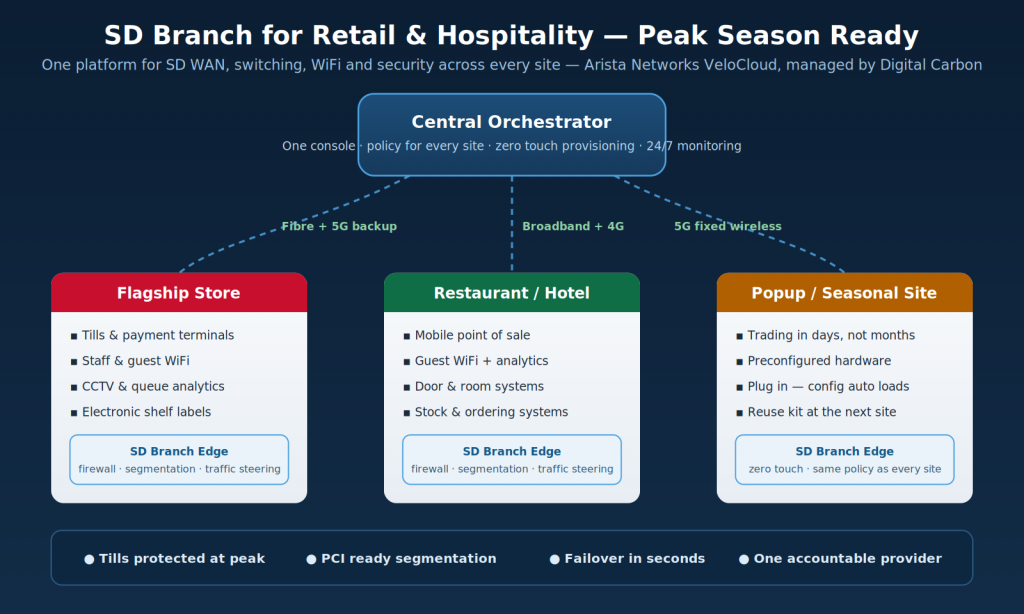
Digital Carbon builds these solutions on the VeloCloud platform from Arista Networks, combining SD WAN, switching, WiFi and edge security under one management console. In practice, that changes the golden quarter picture in four ways.
First, resilience. Each site blends multiple connections, whether broadband, fibre, or 4G and 5G fixed wireless, into one intelligent fabric. The platform measures every link continuously for loss, latency and jitter, and steers each application over the best available path in real time. If the fibre outside your flagship store fails on Black Friday, payment traffic shifts to 5G in seconds and the tills keep ringing. Backup capacity can even run on a pay as you go basis, so you are not funding idle bandwidth for eleven months of the year.
Second, performance where it matters. Application-aware traffic steering means payment authorisation, stock lookups and click and collect systems take priority over guest browsing automatically, at every site, without an engineer touching a single store router. When trading peaks, the network protects the transactions.
Third, security built into the fabric rather than bolted on. Payment devices, corporate systems, CCTV, IoT sensors and guest WiFi each live in strictly segregated zones, enforced identically at every location from a central policy. If a device on the guest network is compromised, there is no lateral path to your tills or your head office systems. That segmentation also dramatically simplifies PCI DSS compliance, because cardholder data traffic is isolated by design across the whole estate. After last year’s attacks, this consistency is precisely what the sector’s postmortems called for.
Fourth, speed of deployment. SD Branch hardware supports zero touch provisioning: kit is preconfigured centrally, shipped to site, and plugged in by whoever is there. It then pulls its full configuration and security policy automatically. A popup store or seasonal concession can be trading securely within days, and when it closes in January the hardware comes back, is reprofiled, and ships out again for the next opening. For international brands, the same model extends across borders, with global connectivity sourced through a single provider rather than a tangle of local carriers.
There is a commercial bonus hiding in the same platform. Modern guest WiFi does more than keep shoppers happy: with analytics built into solutions such as Arista Networks Cognitive WiFi, the same access points reveal footfall patterns, dwell times and repeat visits, turning the network from a cost centre into a source of trading insight your merchandising team will actually use during peak.
Choosing Between SD Branch Providers Before Peak
The technology case is well established. The practical question, with the golden quarter approaching fast, is delivery. Retail and hospitality IT teams are already stretched across peak preparations, and rolling out a new branch architecture across fifty or five hundred sites is not a project most can absorb alone in the time available.
That is why the choice between SD Branch providers matters as much as the choice of platform, and why so many retailers now opt for a managed SD WAN model. Digital Carbon’s jointly managed approach means our engineers design the solution, arrange the circuits, preconfigure and ship the hardware, and then monitor and operate the network around the clock, while your team keeps full visibility and control through the VeloCloud orchestrator. You stay in command of policy and priorities; we carry the operational load, from the connectivity itself down to the switches and access points on your shop floor. Costs are predictable per site per month, which finance teams appreciate, and new sites can be added at the pace your property team signs leases.
Crucially, a phased rollout can begin delivering value before this peak, not after it. Many of our retail and hospitality clients start with their most critical or most troublesome sites, prove the model during the busiest weeks of the year, and then migrate the wider estate in the calmer months that follow.
Make This Your Last Unprepared Peak
Every golden quarter produces the same stories: the retailer whose tills froze at the worst moment, the restaurant chain whose WiFi collapsed under load, the brand that discovered a breach in December. It also produces quieter stories that never make the press, of estates that simply worked, because the network beneath them was designed for exactly this.
If you would like to know which story your estate would tell this year, our experts run practical, no obligation workshops for retail and hospitality teams. We will review your current branch architecture, identify where peak load and security risk sit today, and show you what an SD Branch design from Digital Carbon and Arista Networks would look like across your sites, including what it would cost per site per month.
Book a workshop with our experts today and walk into the golden quarter knowing your network is the one part of peak you do not need to worry about.