

A piece of European law that became a network problem
Most logistics businesses met the EU Data Act the way they meet any regulation with a long lead time. Someone in legal read it. Someone in procurement noted the date. IT heard nothing. It became applicable on 12 September 2025, and a year on, that silence is starting to cost money.
The Act gives the user of a connected product the right to access the data that product generates in normal use, and to pass it to whoever they choose. Read that again with your asset register open. A refrigerated trailer is a connected product. So is a tracked container, a yard crane, a forklift, a tachograph unit and a shelf of warehouse sensors. The operator running them can now ask for the raw feed instead of whatever the vendor dashboard chooses to display. Article 29 goes further and removes cloud switching charges altogether from 12 January 2027. The Commission sets out the whole regime on its Data Act policy page.
So you have new rights. The awkward part is that a right to data you cannot physically move is worth about as much as a key to a door you cannot reach.
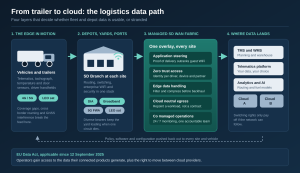
Figure 1: The logistics data path. New rights over your data only start paying at layer three.
The audit nobody enjoys
Pick three feeds you would want if a vendor handed them over tomorrow. Trailer temperature at one minute resolution. Proof of delivery images at full quality. Yard camera analytics. Now trace each one from the asset to your own analytics platform and mark the point where it stops.
For most estates it stops early, usually at the vehicle. The bearer was specified years ago for a few position pings an hour, not a continuous sensor stream, and real European coverage bears little resemblance to the national maps used to justify it. Depots are the second failure point, connected with one broadband circuit on the assumption that the warehouse management system was the only thing that mattered. At the boundary there is often no policy layer at all, so a shift handover, a video upload and somebody’s guest device compete for the same megabit on a first come basis.
None of that is a data rights problem. It is plumbing. And plumbing is why this Act will hand a real advantage to some operators and nothing whatsoever to others.
Remote connectivity is a design job, not a procurement one
Logistics is the only sector where a serious share of the IT estate is doing seventy miles an hour.
Two things make it awkward. No single bearer covers a European operation: 4G and 5G are excellent on trunk routes and missing in the places where distribution centres get planning permission. And positioning itself can no longer be taken on trust, which is the newer problem and the less widely appreciated one. EASA published revision 4 of its safety bulletin on GNSS interference on 3 July 2026, after analysing jamming and spoofing occurrences. Aviation feels that first, but the same interference reaches road transport, where it corrupts timestamps and geofence events without announcing itself.
Bearer diversity with intelligent selection is the way out. Low earth orbit satellite has shifted this conversation more than anything else in the past five years, because throughput and latency now support interactive applications, where once it was overnight batch upload or nothing. A 5G primary with LEO backup at a remote distribution centre turns a dead circuit into reduced bandwidth. That is a very different Monday morning conversation with your operations director.
Depots are where the data piles up
Vehicles make the data. Depots, yards and cross dock sites are where it accumulates, gets enriched and gets handed to the business. SD Branch addresses that layer: routing, switching, wireless and security delivered and managed as one stack per site, in place of four procurements and four support contracts.
The wireless half gets less attention than it deserves, and that is precisely because a yard with patchy coverage does not fail cleanly. Handhelds queue scans. Drivers drift towards the one bay with reliable signal. Timestamps come out subtly wrong and no report flags it, because nothing technically broke. Getting dense surveyed coverage across concrete, steel and moving metal is physical engineering, which is why we work with our installation partner StarLink Solutions on enterprise WiFi installation, 5G broadband installation and satellite internet solutions at UK and European sites. A clever overlay will not rescue an access point mounted in the wrong place. An immaculate survey will not rescue a network with no policy intelligence.
Cloud switching rights are a WAN question
Article 29 is the limb most likely to catch IT leaders out, because on paper it reads like a procurement win.
Watch what happens when a logistics business actually moves its telematics warehouse, or its route optimisation workload, between hyperscalers. The data migrates in weeks. The network takes months, because the private interconnects, egress paths, firewall policy, identity integration and site routing were all built around a destination that is no longer the destination. You end up holding a legal right to switch and an architecture built on the assumption you never would.
This is where the SD WAN benefits stop being slideware. An overlay that treats cloud egress as a policy decision instead of a cabling decision lets you repoint a workload without reopening a single site circuit. Add secure access service edge and zero trust access, and the same change lands identically on the depot, the driver handheld and the customs broker, because policy follows identity, not location. The vendors have moved this way too. Arista bought the VeloCloud SD WAN portfolio from Broadcom in July 2025, and that portfolio ships edge hardware with integrated firewalling and a choice of WiFi, 5G mobile connectivity or both.
Why managed changes things
All of the above can be bought as equipment. Far fewer logistics IT teams can staff it across forty sites, six countries and a fleet while still delivering whatever the business asked for this quarter.
That is the honest case for managed SD WAN, and it has little to do with difficulty. The operational load of a distributed estate has outgrown the teams that inherited it. Holding architecture, configuration, deployment, field engineering and round the clock monitoring with managed SD WAN providers, under one accountable arrangement, turns a permanent recruitment problem into a service with defined outcomes. Your engineers get to design for the next three years instead of chasing a circuit fault in Zeebrugge at eleven at night.
Global connectivity works the same way. Sourcing broadband, direct internet access, fixed wireless and satellite country by country is a procurement exercise with no end state. One managed portfolio with a single support path scales with the network, not against it.
Four things worth doing this quarter
- Inventory the connected products and who currently holds their data. You cannot exercise a right you have not mapped, so start where better data changes a decision: refrigeration, trailer utilisation, yard throughput.
- Audit bearer diversity site by site, not nationally. One circuit is one circuit whatever the headline speed, and the sites with no second physical path are the ones to find.
- Write down honestly what would happen if you wanted to change cloud provider. If the answer runs past four weeks, your constraint is the wide area network and not the data.
- Survey the yards and warehouses again. Coverage assumptions made five years ago were not made against today’s device density or video volumes.
Make the right worth something
The operators who get value out of the Data Act will mostly be the ones whose networks could already move the data on the day they asked for it. The legal reading was always going to be the easy part.
If you want to work out what your estate would need, our experts run a focused workshop covering bearer strategy for vehicles and remote sites, SD Branch design for depots and yards, and a cloud neutral wide area architecture that keeps your switching rights real.