

Here Is What That Means for Your Construction Sites
This week, SpaceX published its first set of results since going public, and the numbers made headlines across the technology press. Quarterly revenue almost doubled to $7.8 billion, with Starlink alone adding $1.7 billion in growth as businesses around the world signed up for satellite connectivity at record pace.
For most readers, that is a story about markets. For IT managers, IT directors and network engineers in construction and engineering, it is confirmation of something far more practical: satellite broadband is no longer a niche fallback for cabins in the wilderness. It is now mainstream, enterprise grade infrastructure, and it is quietly solving one of the oldest and most stubborn problems in the industry: how do you get a new site connected on day one?
The Construction Connectivity Problem
Every construction IT leader knows the routine. The commercial team wins a project. The programme starts in three weeks. The site team needs a Common Data Environment, BIM collaboration tools, CCTV, access control, biometric turnstiles, telematics on plant, and video calls with the design team, all from a muddy field or a part demolished building with no fixed line infrastructure whatsoever.
Then you call the carrier and ask for a fibre circuit. The lead time comes back: sixty to ninety working days if you are lucky, longer if there is civil engineering work involved. On a project measured in months, you might spend a third of the programme waiting for the connectivity the programme depends on. Wayleaves, dig permissions and access disputes can stretch that further still.
The consequences are familiar. Site teams limp along on consumer dongles and personal hotspots. Drawings get taken to site on USB sticks. Progress photos upload overnight, if at all. Security cameras record locally instead of streaming to your monitoring centre. And your service desk spends its week fighting connectivity fires on temporary kit that was never designed for the job.
This is precisely the gap that modern remote connectivity closes, and the Starlink results explain why the timing matters. Low earth orbit satellite services now deliver hundreds of megabits with latency low enough for video conferencing and cloud applications, from anywhere with a clear view of the sky. Combined with 5G fixed wireless access, a construction site can have enterprise class bandwidth on the first morning of mobilisation, not in month three.
A Fast Link Is Not a Network
Here is the part that gets missed in the excitement about satellite speeds: bandwidth is only the raw material. A dish on a cabin roof gives you a fast internet connection. It does not give you a secure, managed, resilient site network. That distinction is where many construction IT teams get burned.
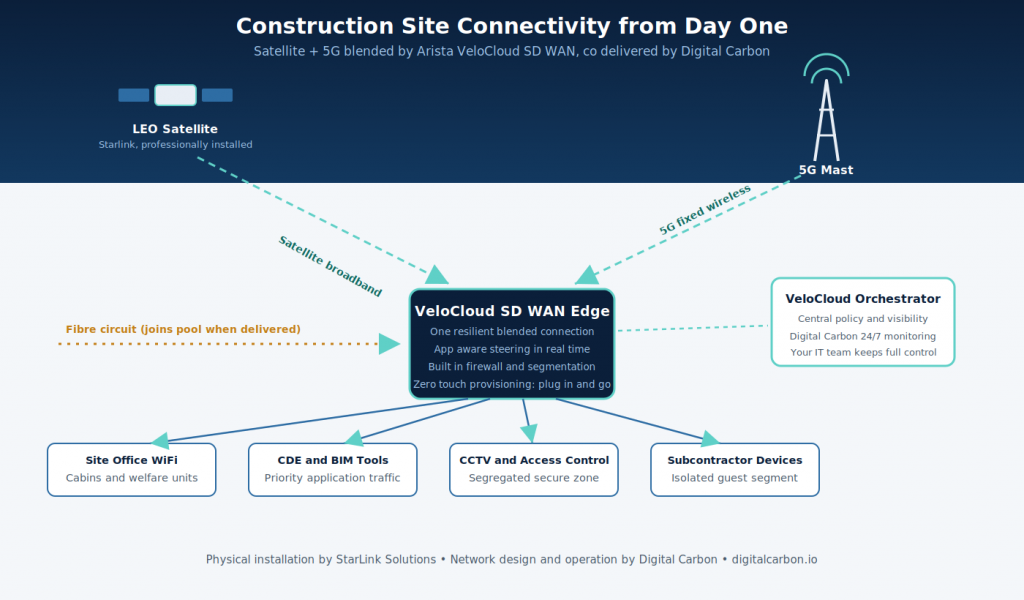
Think about what a live site actually needs from its network. The Common Data Environment and BIM platforms need priority over general browsing, because a stalled model sync stops a coordination meeting in its tracks. CCTV and access control need segregation from corporate traffic and third party subcontractor devices. Site offices need dependable WiFi that covers cabins, welfare units and open work areas. And when a single link degrades, whether from weather, congestion or a mast fault, the site cannot simply go dark.
This is the job of SD WAN. Software defined WAN solutions sit above the individual circuits and treat them as a pool: satellite, 5G, and a fixed line when one eventually arrives, all blended into a single resilient connection. The Arista VeloCloud platform, which Digital Carbon deploys and operates for construction and engineering clients, continuously measures every link for loss, latency and jitter, then steers each application over the best available path in real time. If the satellite link degrades in heavy rain, business critical traffic shifts to 5G within seconds and nobody on site notices. When your fibre circuit finally lands in month three, it simply joins the pool, and the wireless links become backup capacity, often on a pay as you go basis, so you are not paying for idle bandwidth.
Security is built into the same edge device rather than bolted on. Firewalling, segmentation between corporate, CCTV, subcontractor and guest networks, and centrally enforced policy mean every site follows the same rules from its first day online. For principal contractors handling sensitive design data and personal information across dozens of joint venture partners, that consistency is worth as much as the bandwidth.
Just as important for a project business: VeloCloud edges support zero touch provisioning. Hardware is configured centrally before it ships, so anyone on site can plug it in and the device pulls its full configuration automatically. When the project ends, the kit comes back, gets reprofiled, and ships to the next site. Your network estate flexes with your order book.
Getting the Physical Layer Right
None of this works if the physical installation is poor. Satellite dishes need correctly surveyed sightlines and secure mounting that survives site conditions and crane movements. 5G antennas need positioning based on actual signal surveys rather than guesswork. Cabins need structured cabling and properly placed access points, not a router balanced on a windowsill.
That is why Digital Carbon works with our installation partner StarLink Solutions, a UK specialist in Starlink installation, 5G broadband installation and enterprise WiFi installation. Their engineers handle the site survey, mounting, cabling and commissioning of the physical estate, while our engineers design and operate the network layer above it. Between the two of us, the entire chain is covered, from the satellites in the sky to the switches and access points in your site cabins, delivered and supported as one accountable service.
Why Construction Firms Choose Managed SD WAN
The technology stack is proven. The practical question for most construction IT leaders is resourcing. Project sites open, move and close constantly, and every one of them is a mini network deployment. Very few in house teams have the capacity to survey, install, configure, monitor and decommission site networks at that tempo while also running the core business systems.
This is where managed SD WAN earns its keep. With Digital Carbon’s jointly managed model, your team keeps full visibility and control through the VeloCloud orchestrator, while our engineers carry the operational load: designing each site package, arranging circuits and wireless services worldwide, shipping preconfigured hardware, monitoring every link around the clock, and standing sites down cleanly at project completion. You get predictable per site costs that can be charged to the project, and your engineers get their evenings back.
The results from SpaceX this week tell us the satellite era of business connectivity has well and truly arrived. The firms that will benefit most are not the ones who simply buy a dish, but the ones who fold this new capability into a properly engineered, secure, managed network, so that every new site starts productive and stays that way.
Get Every Site Online from Day One
If slow circuit lead times, patchy site connectivity or overstretched engineers sound familiar, it is worth seeing what a modern site connectivity blueprint would look like for your projects. Our experts run practical, no obligation workshops for construction and engineering teams: we map a typical project lifecycle, design the connectivity package for it, and show you exactly what it would cost per site per month.
Book a workshop with our experts today and make waiting for connectivity a thing of the past.