

If you run IT for a transport and logistics business, 2026 has already given you plenty to think about. Research from supply chain risk specialists Everstream Analytics projects that cyberattacks targeting logistics companies will double in 2026, continuing a trend that has seen incidents surge nearly 1,000% since 2021. In 2025 alone, recorded attacks on carriers, ports and third-party logistics providers jumped 61%, from 132 to 213 incidents.
The most worrying part is not the volume — it is the shift in tactics. Attackers are no longer just targeting individual companies. They are going after shared transportation networks, freight platforms and connected supply chain infrastructure, where a single breach can ripple across thousands of businesses at once.
For IT managers, IT directors and network engineers in the sector, this changes the conversation. Cybersecurity is no longer something that lives solely in the SOC or on the endpoint. In a business built on depots, warehouses, cross-docks, ports and distribution centres, the wide area network itself is now part of the front line — and for many operators, it is the weakest part.
Why Transport & Logistics Is Such an Attractive Target
Logistics operations have three characteristics that attackers love.
First, they are highly distributed. A mid-sized operator might run a head office, a dozen regional depots, several warehouses and a growing number of temporary or seasonal sites. Each location typically has its own router, its own firewall, its own local configuration — and its own quirks. Every one of those sites is a potential way in.
Second, downtime is intolerable and expensive. When a warehouse management system goes offline, trucks queue, dock doors sit idle, SLAs are breached and penalty clauses kick in. Attackers know that businesses under that kind of operational pressure are more likely to pay a ransom quickly.
Third, the operational technology estate is exploding. Handheld scanners, RFID readers, telematics units, automated sortation, CCTV, temperature sensors, yard management cameras — all of it connected, much of it running on hardware that was never designed with security in mind. In many depots, this OT traffic shares the same flat network as corporate IT and third-party carrier systems, which means one compromised barcode scanner can become a route to your ERP.
Traditional site-by-site networking makes all three problems worse. When every location is configured individually, security policies drift, patches get missed, and nobody has a single view of what is actually happening across the estate. The UK’s National Cyber Security Centre has repeatedly highlighted supply chain security as one of the areas where organisations have the least visibility — and visibility is precisely what legacy WAN architectures fail to provide.
The Network Is the Control Point You Already Own
Here is the reframe worth making in 2026: rather than treating the network as plumbing that security gets bolted onto, modern SD-WAN solutions turn the network itself into the enforcement layer.
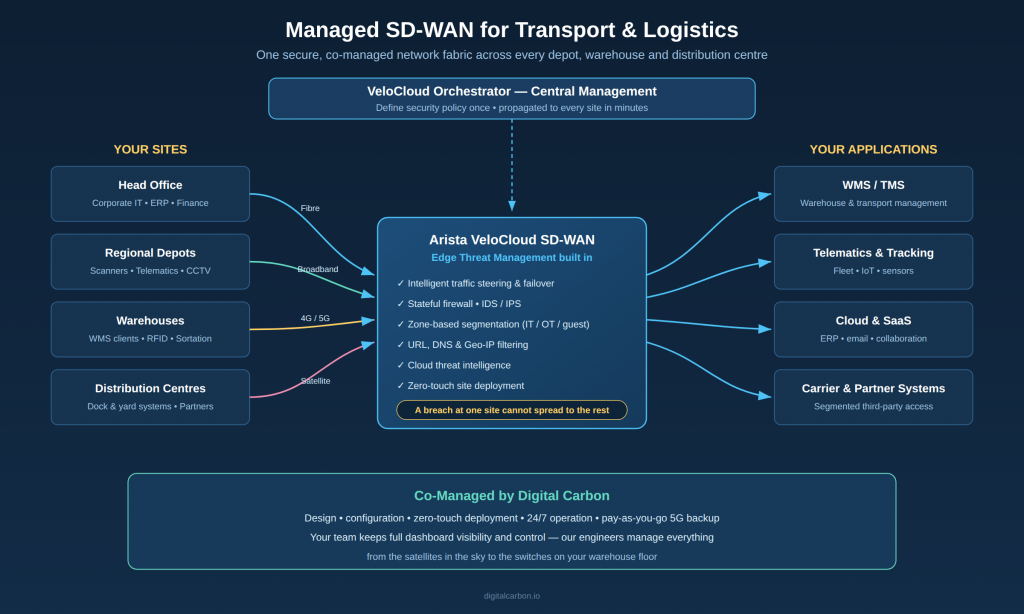
Software-defined WAN replaces the patchwork of individually managed routers and firewalls with a centrally orchestrated fabric. Every depot, warehouse and office connects through an intelligent edge device that combines connectivity, traffic steering and security in a single platform, all managed from one console.
Platforms such as Arista VeloCloud take this further with Edge Threat Management — enterprise-grade security built directly into the SD-WAN edge, including stateful firewalling, intrusion detection and prevention, URL and DNS filtering, Geo-IP filtering, and real-time threat intelligence drawn from cloud-based reputation feeds. Security policies are defined once in the VeloCloud Orchestrator and propagated across the entire network within minutes — not rolled out site by site over weeks.
The SD-WAN Benefits That Matter Most in Logistics
Plenty has been written about generic SD-WAN benefits — lower circuit costs, better application performance, simpler management. All true. But for transport and logistics specifically, four capabilities stand out against this year’s threat landscape.
Segmentation that contains a breach. With zone-based segmentation enforced at every edge, your OT devices, corporate IT, carrier integrations and guest traffic live in strictly separated network segments. If a scanner or telematics unit is compromised, the attacker cannot move laterally into your WMS or finance systems. Given that Everstream’s data shows attackers deliberately targeting shared infrastructure to maximise ripple effects, containment is arguably the single most valuable control you can deploy this year.
Resilience that keeps freight moving. SD-WAN continuously monitors every available link — fibre, broadband, 4G/5G fixed wireless, even satellite — and steers traffic in real time. If a primary circuit fails or degrades, critical applications such as your WMS, transport management system and telematics fail over in seconds, not hours. Pay-as-you-go 5G backup means even a digger through the fibre outside your busiest distribution centre does not stop the operation.
Consistent policy, everywhere, instantly. When a new threat emerges, you update the policy once and every site is protected within minutes. Compare that with dispatching engineers or remote sessions to fifty depots. For lean logistics IT teams, this is the difference between reacting in hours and reacting in weeks.
Zero-touch deployment for a business that never stands still. Logistics estates change constantly — new contracts, new warehouses, seasonal peak sites. With SD-WAN, pre-configured edge hardware ships to site, is plugged in by anyone on the ground, and automatically pulls its full configuration and security policy from the orchestrator. New sites come online in days, secure from the first packet.
Why Managed SD-WAN Is the Realistic Route for Most Operators
The technology case is clear. The harder question for most logistics IT leaders is capacity: who is going to design, deploy and run all of this across a distributed estate while also handling everything else on the roadmap?
That is where managed SD-WAN comes in — and why it has become the default route for mid-market transport and logistics businesses. Rather than adding headcount to build in-house expertise in a new platform, you partner with a provider whose engineers do this every day.
Digital Carbon’s co-managed connectivity model is designed precisely for this. We work alongside your IT team to deliver end-to-end site connectivity — design, configuration, deployment and ongoing operation — through a single accountable provider. Your team keeps full visibility and control through the VeloCloud dashboards; our engineers handle the detailed tuning, vendor escalations and day-to-day optimisation, managing the entire chain from the satellites in the sky to the switches and access points on your warehouse floor.
The result: enterprise-grade, secure connectivity across every site, without your team carrying the operational load alone — and without waiting for the attack statistics to prove the point the hard way.
Get Ahead of the 2026 Threat Curve
The doubling of attacks on logistics is a forecast, not a certainty — but the trend line since 2021 leaves little room for complacency. The operators who fare best this year will be those who treat the network as their first line of defence rather than an afterthought.
If you would like to explore what a secure, co-managed SD-WAN architecture would look like across your depots, warehouses and distribution centres, our experts run practical, no-obligation workshops tailored to transport and logistics environments. We will map your current estate, identify the gaps, and show you exactly how a co-managed VeloCloud deployment would work for your operation.
Book a workshop with our experts today — and make 2026 the year your network becomes an asset, not an attack surface.