

Footfall, Dwell Time and Conversion
The wireless network you already run is quietly collecting some of the most valuable business intelligence in your estate. Here’s how retail and hospitality operators can put it to work — without compromising security or GDPR compliance.
Walk through any shopping centre, hotel lobby or high-street store and almost every person you pass is carrying at least one WiFi-enabled device. Each of those devices is quietly announcing its presence to the wireless networks around it. If you operate enterprise WiFi — and in retail and hospitality, you almost certainly do — that signal data is washing over your access points every minute of every trading day.
Most operators use the network for one thing: connectivity. Guests get online, tills and hand-held scanners stay connected, and the IT team moves on to the next ticket. But platforms such as Arista Cognitive WiFi treat the wireless estate as a sensor network as well as an access network. The analytics it produces — footfall, dwell time, loyalty, conversion — amount to business intelligence that most retailers are, quite literally, sitting on.
This article looks at what that data actually is, what your operations and marketing colleagues can do with it, and what IT managers and engineers should know before switching it on.
Your access points see more than you think
Every smartphone periodically sends out probe requests as it searches for known networks. Arista’s platform gathers presence data for all WiFi devices in range — including those that never connect to your network. That distinction matters: you are not just measuring the guests who log in to your captive portal; you are measuring everyone who walks in, and everyone who walks past.
From that raw signal data, the platform derives a set of metrics that will sound instantly familiar to anyone on the commercial side of the business:
- Footfall — the number of WiFi devices detected in and around a location, a reliable proxy for visitor numbers.
- Dwell time — how long visitors remain on site, broken down by day and by location.
- New versus repeat visitors — how much of your traffic is returning custom, and how frequently those visitors come back.
- Connection volume and duration — how many guests actually use your WiFi, and for how long.
Crucially, every metric can be viewed intra-day, daily, weekly, monthly or year-on-year, for a single site or aggregated across the whole estate. For a multi-site retailer or hotel group, that like-for-like comparison across locations is precisely the view that spreadsheets and door counters struggle to provide.
From passers-by to paying customers
Footfall tells you how many people came in. Conversion analytics tells you something arguably more valuable: how many nearly did. By analysing signal strength, Arista Guest Manager distinguishes devices detected outside a store from those that actually entered, producing a conversion rate for every site, every day.
That one number opens up a series of very practical questions. Did the new window display shift conversion this week? Why does one store convert passing trade at twice the rate of another? Did the weekend promotion pull people in from the street, or simply reward those who were coming anyway? Marketing teams have wanted evidence-based answers to these questions for years — the wireless network can now provide them.
The heatmap of your shop floor
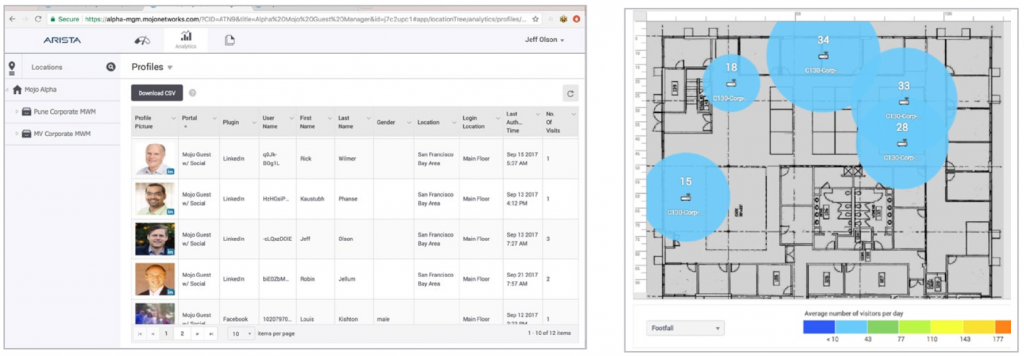
Zone-based analytics take the same data and plot it onto a floor map, showing visitor density, distribution and dwell time around each access point. Zones can be demarcated as regions on the map, letting administrators watch how different parts of a facility are populated over time.
For a retailer, that means seeing which departments pull shoppers in, where queues build at peak times, and which corners of the floor are effectively dead space. For a hotel or venue, it means understanding how guests actually flow between lobby, bar, restaurant and conference areas — evidence that can inform everything from staff rotas to refurbishment plans.
Who your guests are — and how often they come back
Presence data is anonymous by design. The richer, personal layer comes from guests who choose to share it. When your captive portal offers social media login, guests who opt in provide demographic information — age, gender, location — alongside details from their public profile. Arista Guest Manager turns this into social analytics dashboards, and its loyalty analytics classify visitors from one-time through to loyal based on visit frequency.
Because Guest Manager exposes powerful web APIs with both push and pull mechanisms, real-time guest profile information can also flow into your CRM or loyalty platform, which can respond with personalised offers or messages. A returning guest can be recognised the moment they reconnect — the foundation of the differentiated, omni-channel engagement your marketing team is being asked to deliver.
What to do with the data on Monday morning
The most enthusiastic consumers of this data usually sit outside IT, and Arista’s own framing reflects that. WiFi analytics inform marketing research (A/B testing of storefront displays, measuring campaign ROI, context-based guest engagement), operations (staff planning and facility utilisation) and IT itself (network planning and design based on real user density).
In practice, that looks like rotas built around measured footfall peaks rather than gut feel; under-used floor space repurposed with evidence behind the decision; and campaign spend judged on measured uplift in footfall and conversion rather than coupon redemptions alone. Guest Manager also generates custom PDF reports, on demand or on a schedule delivered by email — so the operations director receives the weekly estate dashboard without ever logging into a network console.
The GDPR question, asked and answered
For a UK or European audience, this is usually the first question — and it has a good answer. Presence analytics are anonymous, statistical information derived from device signals. The personal layer exists only for guests who explicitly opt in through social login or a web form on your portal. Arista provides GDPR-compliant cloud WiFi to its partners, resellers and customers in the European Union, with the Arista Cloud acting as a GDPR Processor of personal data, and the platform’s wider security posture — encryption in transit and at rest, strong access controls, SSAE SOC 2 Type II certification — supports rather than complicates a data protection impact assessment.
Pair that with transparent terms on your splash page and analytics becomes a fair value exchange your guests knowingly accept: fast, free WiFi in return for permission to say hello properly.
The infrastructure behind the insight
Here is the part that matters most to the engineers. Both Guest Manager and the CloudVision CUE (CV-CUE) management platform are cloud-hosted services, so there are no portal servers or analytics appliances to rack, patch and back up on site. The access points follow Arista’s controllerless architecture: configuration is managed centrally, but forwarding and control decisions are made locally, so guest access keeps working even if the connection to the cloud is interrupted.
The same platform that produces the analytics also enforces the security model around it. Guest traffic is segregated from corporate and point-of-sale systems through firewall rules, role-based control, traffic shaping and wireless intrusion prevention — keeping the guest experience generous and the cardholder data environment untouched, which your PCI assessor will appreciate.
There is one dependency you cannot design away: the WAN. The analytics and management planes live in the cloud, and your tills, scanners and booking systems depend on connectivity too. This is where Arista VeloCloud SD-WAN completes the picture. It aggregates whatever transport a site can get — broadband, 4G/5G, fixed wireless access, even satellite — and steers traffic intelligently so point-of-sale and guest services stay up even when an individual circuit fails. In one recent evaluation, VeloCloud SD-WAN mitigated 86% of total or partial outages per retail site each month. Zero-touch provisioning means a pop-up shop or new store can come online in minutes, WiFi analytics included, without an engineer on site.
Getting there without adding headcount
None of this is worth much if it lands on a team that is already stretched. Most retail and hospitality IT departments run lean, supporting dozens or hundreds of sites with a handful of engineers — which is exactly why Digital Carbon is built around co-managed services. We operate the Arista WiFi estate, the guest analytics platform and the underlying connectivity as SD-WAN managed services, acting as an extension of your IT function rather than a replacement for it. Your team retains policy control, visibility and final decision-making; ours provides the specialist depth, the monitoring and the day-to-day operational load.
Our engagement model follows a clear path: a discovery workshop, a live demonstration, a tailored budgetary proposal, a proof of concept over three to six months, and then a phased rollout across your sites at the pace that suits your business.
The devices are already in your stores. The signals are already in the air. The only question is whether your network is listening.
Ready to see what your WiFi already knows? Book a discovery call with Digital Carbon today.