

What IT Leaders Need to Know Before They Deploy
Starlink is rapidly changing what is possible for construction sites that have historically been held back by slow, expensive or simply unavailable fixed-line connectivity. But deploying Starlink without the right enterprise layer underneath it is a risk that IT leaders in the construction industry cannot afford to take.
This article sets out exactly what you need to understand before you deploy Starlink on a construction project – covering performance, limitations, security, and how pairing it with the right sd wan solutions transforms a satellite internet service into a fully enterprise-grade WAN.
Why Construction Connectivity Has Always Been a Problem
Construction is one of the most distributed industries there is. A single organisation may be running dozens of concurrent projects, each with temporary site offices, cabins, and remote locations that need access to cloud-hosted Building Information Modelling (BIM) platforms, project management tools, CCTV, collaboration suites, and internal systems.
Traditional fixed-line provisioning is simply too slow for a sector that moves at project pace. Leased lines and MPLS circuits can take weeks or months to install, and when a project ends, those sunk infrastructure costs offer no return. Single-carrier 4G/5G solutions have helped, but coverage remains patchy on remote or rural builds, and a single wireless link without redundancy introduces real operational risk.
The arrival of Starlink’s low Earth orbit (LEO) satellite internet changes the starting assumptions significantly, but it is not a plug-and-play enterprise solution on its own.
What Starlink Actually Delivers on a Construction Site
Starlink’s Performance Kit delivers download speeds that can exceed 400 Mbps with latency as low as 20 milliseconds – a dramatic improvement over traditional geostationary satellite services, which typically suffer from 600 ms or more of latency. For a temporary site office that previously had no viable connectivity option, this represents a step change in what is operationally possible.
The hardware is ruggedised for outdoor and harsh-environment deployment, rated to withstand temperatures from −40°C to +60°C, high winds, dust, vibration, and heavy rainfall – all conditions that construction sites regularly produce. The flat-panel antenna requires only a clear view of the sky and can be mounted on cabins, portakabins, or temporary structures quickly without the need for specialist installation teams.
For construction IT leaders, the practical implication is that any project site, anywhere, can be connected in hours rather than weeks – including rural infrastructure projects, remote quarries, and temporary pop-up locations where no terrestrial connectivity exists.
The Limitations You Must Plan For
Before deploying Starlink as a standalone solution, there are several limitations that every IT leader needs to understand clearly.
Variable link quality. LEO satellite connections are subject to fluctuations in packet loss, jitter, and latency caused by distance to gateways, atmospheric conditions, local obstructions such as trees and buildings, and congestion on shared infrastructure. In field testing, standard LEO satellite connections demonstrated extreme degradation for both voice and video traffic before any optimisation was applied.
No built-in redundancy. A single Starlink terminal is a single point of failure. For business-critical applications such as BIM, remote desktop sessions, or CCTV monitoring, relying on one link without failover means that when that link goes down, so does your site.
Bandwidth caps and cost sensitivity. Exceeding monthly data thresholds can result in throttling or significantly increased costs, and without intelligent application management, non-critical traffic such as streaming or software updates will consume the same bandwidth as your business-critical platforms.
Security by default is limited. Starlink provides internet access, not enterprise security. Without a security overlay, data traversing the satellite link is not protected to the standard that project intellectual property, subcontractor access, and CCTV feeds require.
These limitations do not disqualify Starlink from construction deployments – far from it. They simply mean that Starlink should be deployed as the transport layer, not the complete network solution.
How SD-WAN Transforms Starlink into an Enterprise Tool
This is where the sd wan benefits become tangible for construction IT leaders. An SD-WAN overlay sits above the Starlink connection (and any other available links) and applies intelligent management that removes the limitations described above.
Arista VeloCloud SD-WAN, deployed by Digital Carbon as a co-managed solution, is purpose-built for exactly this scenario. It has already transformed more than one million consumer-grade circuits – including 5G FWA and LEO satellite – into enterprise-grade connectivity for tens of thousands of customers worldwide.
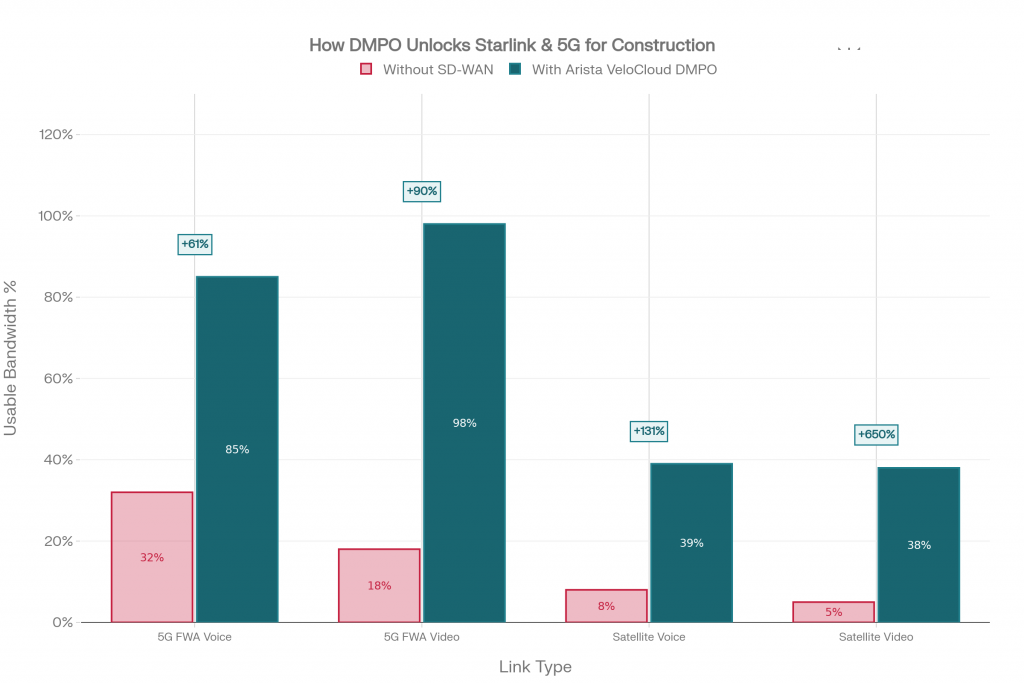
Dynamic Multipath Optimisation (DMPO) is the core capability that changes the performance equation. DMPO continuously monitors packet loss, latency, and jitter on every available link and applies forward error correction, jitter buffering, and intelligent packet steering in real time. In field tests:
-
DMPO increased usable bandwidth on 5G FWA links by up to 90% for both voice and video
-
For LEO satellite connections, DMPO boosted usable bandwidth by up to 650% for video workloads
For a construction site where the only connectivity option is Starlink, those figures mean the difference between a site that can reliably run BIM sessions, video calls, and remote surveillance, and one that cannot.
Direct Internet Access, Application Priorities and Security
One of the key sd wan benefits for construction is the ability to configure secure direct internet access from each project site directly to cloud platforms, rather than backhauling traffic through a central data centre. This gives BIM, Office 365, project collaboration tools, and other SaaS applications the lowest possible latency path, regardless of which site they are accessed from.
VeloCloud SD-WAN classifies and prioritises over 4,000 applications by default, allowing IT leaders to define business outcomes once and have the SD-WAN enforce them automatically across every site. A policy such as “BIM and collaboration tools must always use the best available link” is configured centrally and applied instantly, without requiring on-site technical resource.
Non-critical applications – including streaming services, software update downloads, and social media – can be deprioritised or blocked during working hours, ensuring that limited Starlink bandwidth is reserved for the traffic that keeps projects moving.
Security is integrated into the same overlay. Context-aware firewalls at each SD-WAN edge enforce policies based on application, user, and device identity rather than just IP addresses, protecting sensitive project data, intellectual property, and subcontractor access. Automatic site-to-site VPNs provide encrypted mesh connectivity between site cabins, design studios, and head office without complex manual configuration.
Zero-Touch Deployment: Getting Sites Online in Minutes
One of the most compelling sd wan solutions benefits for construction IT teams is zero-touch provisioning. VeloCloud SD-WAN edge devices are shipped pre-configured and pre-activated, including built-in dual SIM and eSIM support for 4G/5G connectivity.
To bring a new project site online, your IT team ships the edge device to site, a non-technical person plugs it into the Starlink terminal, and the device automatically connects to the SD-WAN fabric with the correct security policies, application priorities, and VPN configuration already in place. There is no need for an engineer on site, no manual configuration, and no delay waiting for IT to travel to a remote location.
As one construction technology leader described after deploying Digital Carbon’s SD-WAN solution: “We were able to utilise a plug-and-play model that significantly simplifies the deployment of our remote project sites.”
For organisations running multiple concurrent projects, this creates a repeatable blueprint: every new site gets the same connectivity design, security posture, and performance standards from day one, regardless of location.
Multi-Transport Resilience: Combining Starlink With Other Links
For project sites where both Starlink and 4G/5G are available, sd wan providers like Digital Carbon can aggregate both connections into a single, high-bandwidth virtual WAN. DMPO steers traffic across both links simultaneously, using each for the traffic it handles best and automatically shifting load when one degrades.
This active-active approach eliminates the single point of failure that a Starlink-only deployment introduces. If the satellite link is temporarily obstructed by weather or equipment movement, 4G/5G picks up the load without interruption. Where broadband or a fixed DIA circuit is available at a permanent office or logistics hub, that can be incorporated into the same fabric alongside Starlink, providing further capacity and resilience.
Visibility and Control Across All Project Sites
Construction IT teams are stretched. Managing connectivity across ten, twenty or fifty concurrent project sites using individual point solutions – separate SIM cards, separate routers, separate firewall policies – is neither scalable nor sustainable.
With co-managed Arista VeloCloud SD-WAN from Digital Carbon, a single cloud-based orchestrator provides real-time visibility into application performance, link utilisation, ISP behaviour, and user experience across every site. IT leaders can see at a glance which sites are healthy, identify degraded links before users notice, and push policy changes to all locations simultaneously without leaving the office.
Enterprise-wide monitoring and reporting support capacity planning, help justify investment decisions to project directors and finance teams, and create an audit trail for security governance.
Digital Carbon’s Co-Managed Model: IT Stays in Control
There is an important distinction between a fully managed service – where a provider locks IT teams out of their own infrastructure – and a co-managed model, where specialist expertise is layered on top of full IT visibility and control.
Digital Carbon operates exclusively on a co-managed basis. Your IT team retains access to the SD-WAN console, analytics, and policy management, while Digital Carbon provides the design expertise, deployment support, ongoing optimisation, and 24/7 escalation path. This means you are not dependent on raising support tickets to make basic changes, and you are not left without support when complex issues arise.
Global connectivity sourcing – including broadband, direct internet access, 4G/5G and Starlink – is handled by Digital Carbon across trusted carrier partners, simplifying procurement significantly for construction firms running projects across multiple regions or countries.
Is Your Project Site Ready for Starlink and SD-WAN?
Starlink is a genuine breakthrough for construction connectivity – but it reaches its full potential only when paired with enterprise-grade sd wan solutions that manage its variability, secure its traffic, and integrate it into a broader multi-transport architecture.
If you are evaluating Starlink for upcoming projects, or trying to standardise connectivity across a portfolio of sites, Digital Carbon offers a complementary Workshop on Modernising Connectivity for Construction for IT teams. We will map your current environment, demonstrate how Starlink and Arista VeloCloud SD-WAN work together in practice, and help you design a repeatable blueprint your team can deploy with confidence on every project.
Book a complementary workshop with Digital Carbon today and see how Starlink, combined with co-managed SD-WAN, can transform connectivity across your construction projects.