

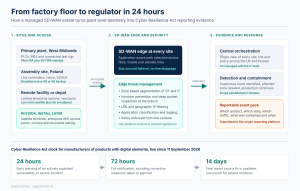
Since 11 September 2026, manufacturers who place products with digital elements on the European market have been working to a clock they did not have before. Under Article 14 of the EU Cyber Resilience Act, an actively exploited vulnerability or a severe security incident affecting one of those products has to be flagged to the relevant national CSIRT and to ENISA within twenty four hours. A fuller notification follows within seventy two hours. A final report is due within fourteen days once a corrective measure exists, or within a month for a severe incident. Everything goes through a single reporting platform operated by ENISA, so there is one submission and one timestamp.
Most manufacturers in the UK and across Europe read this as a product security problem, which is fair enough. Firmware teams, secure development practice, software bills of materials, vulnerability disclosure policy. All of that matters. But something else lands on the network team, and it tends to surface at about hour three of a real incident. Almost the whole twenty four hours gets spent working out what actually happened. Writing it up is the quick bit.
The question nobody can answer from a spreadsheet
A security researcher publishes evidence that a widely deployed controller, one that sits inside a product line you ship to customers across the EEC, is being exploited. Your product security lead starts asking. Are any of our own facilities running the affected component? Did anything talk to the indicators of compromise published this morning? Which of our twelve sites, four of them in other countries and two inherited through acquisition, are actually exposed? Has anything moved laterally from the test rig network into the production line?
If answering that means ringing round site managers, pulling logs off four different firewall brands and waiting on a third party to export something, most of the clock has gone before you have a sentence worth submitting. The questions are network questions. The product team cannot answer them.
So the architecture of your wide area network has quietly become part of your compliance posture. A fragmented estate of regional broadband circuits, local firewalls bought at different times from different resellers and site networks configured by whoever happened to be available that week produces one kind of answer under regulatory pressure: slow, partial and heavily caveated. A consistent, centrally orchestrated estate produces one you can stand behind.
Why this is pushing manufacturers towards managed SD-WAN
SD-WAN in manufacturing has usually been sold on cost and uptime. Replace expensive private circuits, bond cheaper internet links, keep the line running when a digger goes through the fibre outside the goods entrance. Those benefits are real and they still pay for the project on their own.
What has changed in 2026 is that the same platform happens to be the most practical place to get visibility and consistent enforcement across an industrial estate that was never designed as one network.
Start with segmentation. Operational technology on a factory floor does not patch on a Tuesday. Legacy PLCs, vision systems and line controllers will outlive several generations of IT policy, so the realistic control is to draw a firm boundary round them and inspect what crosses it. Doing that once, centrally, so it applies identically in Birmingham, Bydgoszcz and Barcelona, beats doing it brilliantly at one site.
Then there is where inspection happens. Backhauling plant traffic to a central breakout adds latency that machine to machine traffic will not tolerate, and local traffic never gets inspected at all. Pushing firewalling, intrusion prevention, deep packet inspection and URL and geographic IP controls into the SD-WAN edge itself deals with both, and it collapses a per site stack of appliances into one platform your team can reason about.
Telemetry is the piece people underrate. On a normal Tuesday the dashboard is mildly interesting. On the morning an advisory drops, “did any site talk to this host in the last ninety days” needs an answer in minutes, and that only happens if the data was already being aggregated somewhere central.
What the Arista Networks and VeloCloud deal changed
The market has moved the same way. Arista Networks completed its acquisition of the VeloCloud SD-WAN business from Broadcom in 2025, putting one of the most widely deployed enterprise SD-WAN platforms alongside a campus, branch and network detection portfolio. In July 2026 Arista announced Edge Threat Management for VeloCloud SD-WAN: advanced firewalling and threat prevention, zone based segmentation, geographic IP filtering, DNS filtering and AI assisted policy insight folded into the existing SD-WAN edge, processed locally at the branch and managed from the same orchestrator. Arista states general availability in the final quarter of 2026, across all current VeloCloud hardware and virtual edge platforms.
If you already run VeloCloud across a manufacturing estate, that matters commercially. The segmentation and inspection capability the Cyber Resilience Act conversation is pushing you towards may turn out to be an upgrade path on hardware you own rather than a fresh procurement cycle. It also tells you something about where the market has landed, since consolidating branch security into the SD-WAN layer is now the mainstream position rather than one vendor’s argument.
Worth being honest about the gap between available and configured, though. Segmentation policy for an industrial network does not come as a default profile. It needs someone who understands both the protocol behaviour on a production line and the enforcement model in the platform, and it needs validating before it is enforced, not after a shift manager rings to say the labelling machines have stopped.
Sites that terrestrial connectivity does not reach
There is a practical wrinkle for manufacturers in particular. Compliance evidence has to come from every site, including the awkward ones. New build facilities waiting months on a fibre installation, quarry and aggregate operations, rural processing plants, temporary production space taken on to cover a demand spike. A site that cannot get a reliable circuit usually ends up with an improvised arrangement nobody has policy over, and that is exactly the site that will not be able to answer when the question comes.
Low orbit satellite and 5G fixed wireless access have changed that picture a great deal. A satellite terminal and a 5G service, both terminated into the same SD-WAN edge as everywhere else, give a remote facility the same policy and the same telemetry as the flagship plant. The links are diverse. The governance stays uniform.
Getting that right on the ground is a physical job as much as a network one. Mounting and alignment, obstruction survey, power and cable routing, enterprise WiFi access point placement across a steel framed production hall where coverage behaves nothing like an office. Digital Carbon works with our install partner StarLink Solutions on exactly this layer, covering satellite internet solutions and Starlink installation across the UK as well as 5G broadband installation and enterprise WiFi installation on live industrial sites. A terminal that was surveyed and documented properly at install is the one still delivering clean telemetry two years later.
What to do before the advisory lands
Whatever platform you run, start by finding out whether you can answer the scoping question today. Pick a plausible indicator of compromise, give your team an hour and see how far they get. The exercise tells you more than any audit will.
Then map the estate honestly, acquired sites included, along with the temporary facilities and the one plant still running a local broadband line somebody set up in 2019. The gap between the architecture diagram and the real network is where the twenty four hour clock gets lost.
And settle where inspection and segmentation policy lives and who owns it. Co managed arrangements tend to work here, because the industrial context sits with your team and the platform depth sits with a specialist. The arrangement that fails is a policy nobody has looked at since deployment.
The Cyber Resilience Act was never meant to be a networking regulation. For manufacturers across the UK and Europe it has become one anyway, because the reporting clock rewards estates you can see across and punishes the ones you cannot.
Book a workshop with our experts
Digital Carbon designs and co manages SD-WAN solutions, SASE and global connectivity for multisite manufacturers across the UK and Europe, working alongside your IT team rather than taking over from it. If you want to pressure test whether your estate could evidence a reportable event inside the window, our engineers will walk your architecture with you and show you where the gaps sit.