
Solving Day-One Connectivity on a Construction Site
The crane is booked. The welfare cabins are lifted into place. The hoarding goes up, the groundworks begin, and within hours the first team is on site. Everyone accepts that the build programme starts the moment the compound lands.
So here is the question most projects don’t ask early enough: what about the network?
A modern construction site is a digital operation from day one. Building information modelling (BIM) files are pulled from the cloud. Site managers run drawings, RFIs and project tools on tablets in the mud. CCTV and access control protect the compound overnight. Deliveries are booked through portals, inductions are completed online, and the project director joins a video call with head office from a portacabin with a kettle and a view of a piling rig. None of that works without fast, reliable connectivity — and yet connectivity is still routinely treated as something to “sort out once we’re settled in.”
The trouble is that the one thing a build programme cannot wait for is a fixed line.
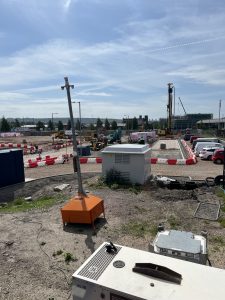
A live residential development: groundworks underway, cabins in, plant and vehicles on site — and not a metre of fixed fibre in sight. The connectivity has to arrive before the permanent infrastructure does.
Why fixed-line connectivity can’t keep up with the build programme
Ordering a leased line or fibre circuit to a brand-new site is a project in its own right. There are wayleaves to negotiate with landowners, civils and trenching to dig the duct, and carrier lead times that routinely run to 30, 60 or 90 days — longer still if a road crossing or a new street cabinet is involved. On a site that may exist for only twelve to twenty-four months before it is demobilised and gone, spending a quarter of the programme simply waiting to get online is not an option.
And the cost of waiting is real. A site team standing idle, unable to open a drawing or sync a model, is one of the most expensive things on any project. So is a delayed mobilisation, a CCTV system that isn’t live on the first night, or a director who can’t dial into a critical design review. Connectivity, in other words, belongs on the critical path — right alongside power, welfare and security — not in the “nice to have, we’ll get to it” column.
The answer isn’t to wait faster. It’s to stop depending on the trench altogether.
The day-one answer is wireless — but raw wireless isn’t enough
This is where two technologies change the game: low Earth orbit (LEO) satellite, in the form of Starlink, and 5G Fixed Wireless Access. Between them, they can put a high-speed connection on a muddy field in hours, with nothing to dig and no carrier queue to join. Point a Starlink dish at the sky, stand up a 5G router, and a site has internet on day one.
But — and this is the part the brochures gloss over — raw wireless on its own is not enterprise-grade. Starlink is remarkable, yet it roams between satellites throughout the day, which introduces jitter and the occasional micro-drop. 5G is blisteringly fast until the cell congests or a delivery lorry parks itself between the antenna and the mast. On their own, either link will happily ruin a Teams call, stall a BIM sync, or freeze a remote desktop session at exactly the wrong moment.
What a site actually needs is a way to take those volatile, consumer-grade links and turn them into something a business can run on. That is precisely what an SD-WAN overlay does — and it is where the right platform earns its keep.
Arista VeloCloud: turning consumer-grade links into an enterprise-grade WAN
When you compare SD-WAN providers and weigh up SD-WAN solutions for this kind of environment, one platform stands out for exactly this problem: Arista VeloCloud.
VeloCloud was founded in 2012 and spent the best part of a decade as one of the recognised SD-WAN leaders — a cloud-delivered, application-aware platform deployed across thousands of enterprises worldwide. In 2025, Arista Networks completed its acquisition of VeloCloud from Broadcom, uniting that proven WAN technology with Arista’s strength in switching and Wi-Fi. For construction, the relevance is immediate: the same platform that secures a high-street store can stabilise a site cabin in a field.
The clever part is a technology Arista calls Dynamic Multipath Optimisation (DMPO). It monitors every available link in real time and applies forward error correction, jitter buffering and intelligent per-packet steering to keep latency-sensitive traffic smooth, even while the underlying connection wobbles. It can aggregate broadband, 5G and satellite into a single virtual WAN, and fail traffic between them seamlessly the instant one degrades. The numbers are striking: in field tests, DMPO has increased usable bandwidth by up to 90% on 5G links and by up to 650% on LEO satellite connections for voice and video workloads. That is the difference between a video call that drops and one that simply works.
Add zero-touch deployment — a pre-staged edge device that you ship to site, plug into whatever connectivity is available, and watch join the network automatically with the correct policies already applied — and you have a WAN that can be live before the concrete is poured.
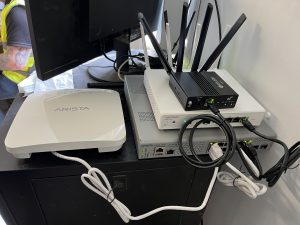
The actual kit from our latest site installation: an Arista Wi-Fi access point, the Arista VeloCloud SD-WAN edge, an Arista PoE switch and a 5G router — the brain of a day-one site network.
Inside the site cabin: what day-one connectivity actually looks like
Strip away the marketing and a resilient site network comes down to a surprisingly compact stack — the one pictured above, installed and running in a working site office.
At its heart sits the Arista VeloCloud SD-WAN edge: the brain that bonds the underlays, enforces policy and keeps every application steered onto the best available path. Beneath it, an Arista PoE switch does the quiet heavy lifting, carrying both data and power down a single cable to access points, CCTV cameras and VoIP handsets — fewer power supplies, tidier cabinets, and the ability to remotely power-cycle a misbehaving device instead of sending someone up a ladder. An Arista Wi-Fi access point blankets the cabins and welfare areas, so phones, tablets and laptops connect the moment people walk in. And the wireless underlays — a 5G router for cellular and a roof-mounted Starlink dish for satellite — give the edge two independent paths to the outside world, so if one falters, the other carries on without anyone noticing.
The result is the photo below: a two-storey stacked-container site office, on a gravel compound, behind traffic barriers — online from the day it was craned into place.
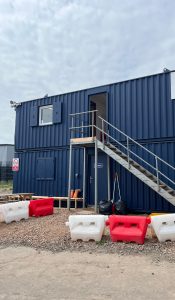
This two-storey site office was connected on day one — no trench, no wayleave, no waiting. Enterprise-grade connectivity on a live construction site.
The physical install: where Starlink Solutions comes in
None of this installs itself. A satellite dish has to be mounted with a clear view of the sky and weatherproofed against a British winter. Cabling has to be run between cabins. Access points have to be sited where the coverage is genuinely needed, not where the ladder happens to reach. On a live construction site, that is skilled, hands-dirty work — and it matters every bit as much as the platform sitting on top of it.
For exactly this, Digital Carbon works with Starlink Solutions, who carried out the physical Starlink installation on this project — mounting and aligning the dish, running the structured cabling, fitting the access points, and delivering the 5G Fixed Wireless Access that underpins the site. With engineers who cover sites nationwide, they make sure the physical foundation is right first time, so the clever overlay always has solid copper — and a clear sky — beneath it.
Co-managed, not locked down: the SD-WAN managed services difference
There is a reason construction IT teams increasingly look for SD-WAN managed services rather than fully outsourced ones: they want the specialist expertise without surrendering control of their own network.
Digital Carbon’s co-managed model gives you precisely that. Your team keeps full visibility, policy access and the final say through the same cloud console, while we handle the day-to-day optimisation, design changes, monitoring and troubleshooting as an extension of your IT function. Because it is delivered as network-as-a-service, the cost aligns with the project lifecycle — no heavy upfront CapEx for a site that won’t exist in two years — and the same kit can be redeployed to the next project when this one wraps up. Security is built in from day one, with a stateful firewall at each edge enforcing policy by application, user and device, and segmentation that keeps sensitive project data and intellectual property protected across the web of subcontractors and joint-venture partners that every build inevitably involves.
Built to mobilise, built to move
The most important shift in thinking is this: on a construction site, the network should behave like everything else on site — quick to mobilise, able to scale from a single cabin to an entire programme, and clean to demobilise when the job is done. With Arista VeloCloud’s zero-touch model, Starlink and 5G acting as genuine business-grade underlays rather than emergency backups, and a co-managed service wrapped around the whole thing, connectivity stops being the item that holds up mobilisation and becomes the one that accelerates it.
You don’t have to wait for the trench. You can be connected before the concrete.
Ready to get your next site connected on day one?
Whether you are mobilising a single project office or rolling out connectivity across an entire portfolio of sites, the best place to start is a conversation. Digital Carbon runs a free, no-obligation workshop where we get to know your projects, your challenges and your programme, then map out the right approach — no jargon, no hard sell, just a practical plan for getting your sites online faster.
Book your free workshop today and discover how a co-managed Arista VeloCloud solution could connect your next site before the concrete is even poured.