
Why SD-Branch Is the Future of Construction Connectivity
Construction projects have changed. Site offices are no longer simple cabins with a printer and a phone line; they are now digital workspaces supporting cloud applications, video collaboration, CCTV, access control, tablets, IoT devices, and real-time project data. As a result, the network has become part of the project itself, because if connectivity fails, productivity, visibility, and security all suffer.
For many construction IT teams, that creates a difficult challenge. New sites need to be connected quickly, often with limited local IT resource, and the network still needs to be secure, resilient, and easy to manage from a central location. Traditional branch networking was never really designed for that kind of environment.
This is where SD-Branch becomes valuable. Instead of treating WAN, switching, Wi‑Fi, and security as separate projects, SD-Branch brings them together into one managed solution, making it easier to deploy, operate, secure, and troubleshoot branch and site networks. For construction organisations, that makes SD-Branch more than a networking upgrade; it becomes a practical way to support faster site mobilisation, stronger security, and lower operational complexity.
In this article, we will look at what SD-Branch actually means, why it matters in construction, and how a solution based on Arista VeloCloud SD‑WAN, Arista switches and Arista access points can help IT teams move from basic site access to secure, well-run digital operations.
Why construction connectivity is different
Construction is not like a standard office environment. Sites are temporary, layouts change, internet options vary by location, and many users on the network are not permanent employees but subcontractors, visitors, consultants, or specialist suppliers. At the same time, more devices are being added to site networks, including IP cameras, smart access systems, printers, sensors, and wireless handheld devices.
That mix creates several problems for IT teams. First, new sites often need to go live quickly, but leased lines or traditional private WAN services can take too long and cost too much. Second, when projects move quickly, field teams often install whatever kit is available, which can lead to consumer-grade routers, unmanaged switches, and inconsistent wireless coverage. Third, separate networking and security products create separate dashboards, separate policies, and separate troubleshooting processes, which makes remote support harder than it needs to be.
This matters because the network on a construction site now supports business-critical activity. Teams rely on Microsoft 365, collaboration tools, design files, cloud platforms, and real-time communications, while IT must also protect user traffic and internal systems from cyber threats. If the WAN is unstable, if the Wi‑Fi is poorly designed, or if security is inconsistent from site to site, the impact is immediate: slow applications, poor user experience, longer support calls, and more risk.
What SD-Branch really means
SD-Branch is best understood as an extension of SD‑WAN into the full branch environment. Instead of managing connectivity, switching, wireless, and edge security separately, SD-Branch brings those functions together under a single operational model. That means policies, visibility, deployment, and troubleshooting can be handled in a more joined-up way.
For a network engineer, that means fewer point products and better end-to-end visibility. For an IT manager or leader, it means the branch or site network becomes easier to standardise, easier to scale, and easier to support with a lean central team.
In practical terms, SD-Branch gives construction firms a repeatable design for each project location. A new site can be deployed using pre-configured hardware, activated with zero-touch provisioning, managed centrally, and monitored through cloud-based tools that provide visibility across WAN, wired, and wireless services. That is a major improvement over the traditional approach of piecing together a WAN router, a separate switch, a separate Wi‑Fi platform, and a separate firewall.
The building blocks of an Arista-based SD-Branch
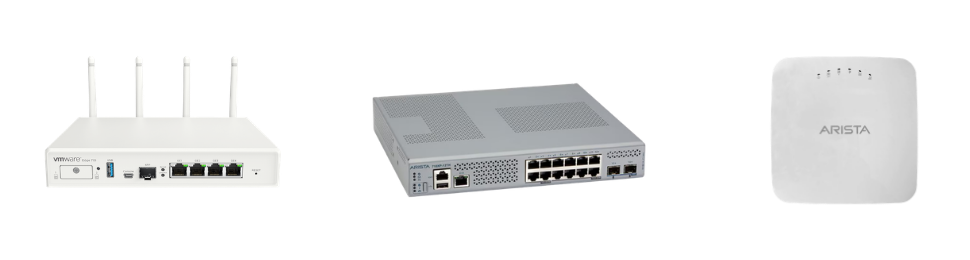
In this design, the foundation is VeloCloud SD‑WAN. VeloCloud improves WAN agility and economics while delivering enterprise-grade performance, visibility, control, and security across public internet and private transport. It supports zero-touch deployment, cloud-based provisioning, one-click business policy, and built-in enhanced firewall services, all managed through the VeloCloud Orchestrator. It also uses Dynamic Multipath Optimisation, or DMPO, to monitor link conditions continuously and steer traffic dynamically over the best available path.
That is especially useful for construction sites, where connectivity may depend on broadband, 4G, 5G, fixed wireless, or mixed access methods. VeloCloud can aggregate multiple links and optimise application delivery in real time, helping critical services such as Teams, cloud applications, and business systems perform more reliably. Because the Orchestrator applies enterprise-wide business policy from the cloud, IT can define how applications should be treated across every site rather than configuring each location manually.
The next layer is the Arista CCS‑710XP switch family. These compact PoE switches are designed for edge and space-constrained environments, with options that support flexible mounting, quiet operation, and deployment outside a traditional wiring cupboard. That makes them highly relevant for site cabins, temporary compounds, gatehouses, welfare units, and other small branch environments where space and noise matter. They also support Zero Touch Provisioning, rich telemetry, 802.1X, RADIUS, VLANs, and integration with CloudVision CUE.
For construction IT teams, PoE matters more than it may first appear. A switch is not only connecting laptops and desks; it may also be powering access points, IP cameras, phones, door systems, and IoT endpoints from the same platform. Using a switch platform designed for adaptive power management and central visibility gives IT much better control than relying on low-cost unmanaged kit installed in a hurry.
The wireless layer comes from Arista Wi‑Fi access points, managed through CloudVision CUE. Arista’s wireless portfolio includes indoor and outdoor Wi‑Fi 6, 6E and Wi‑Fi 7 access points, with central configuration and localised data and control planes. This architecture matters because it avoids a single point of failure; even if the connection to the cloud is disrupted, local forwarding and runtime operations remain active. In construction, where internet quality can vary by site, that resilience is particularly valuable.
CloudVision CUE is what ties the wired and wireless experience together. It provides a cloud-hosted management platform with zero-touch deployment, unified dashboards, AI-driven analytics, rapid troubleshooting, and visibility into both infrastructure and client experience. Arista also highlights capabilities such as Client Journey, which tracks services including DHCP, DNS, authentication, QoS, and URL access, helping administrators understand exactly where a user’s connectivity problem is occurring. For a support engineer, that is far more useful than simply seeing that an access point is “online”.
Why the VeloCloud Orchestrator matters
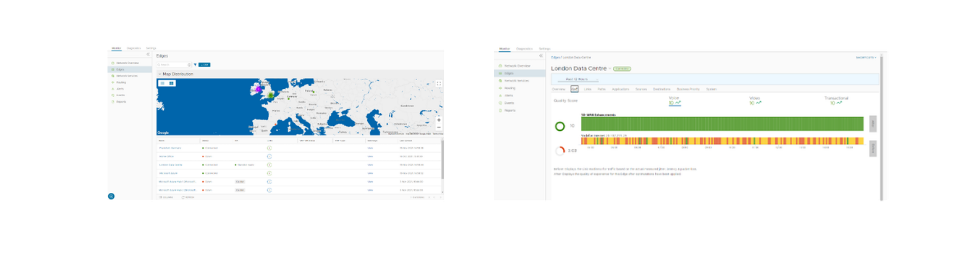
One of the most useful points in this design is that the VeloCloud Orchestrator acts as the main SD-Branch management portal. VeloCloud’s architecture uses the Orchestrator for provisioning, policy, troubleshooting, monitoring, and reporting across the SD‑WAN environment. In the material you provided, the SD‑Branch approach places VCO as the primary orchestrator, while telemetry from CloudVision CUE expands visibility into the managed LAN, and Wi‑Fi.
That is important because operations become simpler when IT has one primary place to manage policy and monitor performance. Instead of asking whether a problem is “the WAN team’s issue” or “the Wi‑Fi team’s issue”, engineers can work from a more unified operational view. For construction organisations with small networking teams, that reduction in complexity can have as much value as the technology itself.
The educational value of SD-Branch for construction IT
If you are a network engineer, one of the biggest lessons here is that SD-Branch is not just a marketing label. It is an architectural shift away from siloed infrastructure and towards policy-driven, telemetry-rich, cloud-managed networking at the edge. That changes how you design networks, because you are no longer only thinking about ports, VLANs, and uplinks; you are also designing for zero-touch rollout, application performance, user experience, and security posture.
If you are an IT manager or IT leader, the educational takeaway is slightly different. SD-Branch gives you a model for standardisation. Instead of every site becoming a custom networking project, you can create a repeatable template: VeloCloud for WAN and security, Arista switches for wired access and PoE, Arista APs for Wi‑Fi, and CloudVision CUE for wired and wireless operations, all under the governance of the VeloCloud Orchestrator.
That standardisation improves several parts of the business at once. It shortens deployment times because hardware can be shipped and activated with zero-touch workflows. It improves support because engineers have better telemetry and AI-assisted visibility into infrastructure and client issues. It improves security because traffic can be segmented and protected consistently, with enhanced firewall services, intrusion prevention, filtering, and centrally configured policies.
A simple real-world way to think about it
Imagine a new project site opening in a location where only broadband and 5G are immediately available. Under a traditional approach, the site might get a basic internet router, a separate Wi‑Fi box, an unmanaged PoE switch, and a VPN back to head office, all configured differently from the previous site. That may get the site online, but it gives IT limited control, weak visibility, and inconsistent security.
Now compare that with SD-Branch. A VeloCloud Edge is shipped to site and connected to available links, bringing the branch online with zero-touch provisioning and central policy from the Orchestrator. An Arista 710XP switch provides structured wired connectivity and PoE for access points, cameras, and phones, while Arista APs deliver centrally configured wireless access. CloudVision CUE gives the IT team visibility into user journeys, RF health, device status, and potential problems, while VeloCloud continues to optimise WAN traffic and apply security policy.
That is the real promise of SD-Branch. It is not just that the network is faster or newer; it is that the whole branch becomes easier to run in a controlled, secure, supportable way.
Why this approach is likely to become the norm
Construction will continue to become more connected. More digital workflows, more IoT, more security requirements, and more reliance on cloud services all push site networks to become more capable and more consistent. As those pressures grow, the old model of separate tools and reactive troubleshooting will become harder to justify.
An SD-Branch architecture based on VeloCloud SD‑WAN, Arista switching, Arista wireless, and CloudVision CUE offers a clear path forward. It combines zero-touch deployment, central management, strong telemetry, AI-driven analytics, secure connectivity, and a design that fits both small remote sites and broader distributed environments. For network engineers, it provides a more intelligent and supportable edge. For IT leaders, it provides a more scalable operating model for construction connectivity.
That is why SD-Branch is not simply the next networking trend for construction. It is becoming the practical foundation for how modern sites are connected, protected, and operated.